If you’ve ever wondered why some sales teams consistently blow past quota while others coast at “good enough,” it often comes down to motivation design. A sales incentive program is a structured strategy that rewards salespeople for hitting specific performance goals: exceeding revenue targets, launching a new product line, growing market share, or retaining key accounts. Rewards range from cash bonuses and merchandise to points-based systems and, most powerfully, group incentive travel.
At Ascent Performance Group, we’ve spent more than 25 years helping companies design incentive travel programs that turn good performers into great ones. Here’s what a sales incentive program actually is, why it works, and how to build one that delivers a real return.

The Case for Sales Incentive Programs
Base salary and standard commission structures are the floor, not the ceiling, of sales motivation. They keep people showing up, but rarely inspire the extra effort needed to win a competitive deal or push through the final stretch of a fiscal quarter. Incentive programs fill that gap with clear, achievable goals tied to meaningful rewards.
The data backs this up. According to the Incentive Research Foundation (IRF), properly structured incentive programs can increase employee performance by 44%. That’s not a marginal bump. It’s a fundamental shift in output. The IRF’s research also shows incentive programs work because they create clarity around priorities: when sales teams know exactly which behaviors, products, or customer segments drive rewards, they align their efforts accordingly, producing higher conversion rates, larger deal sizes, and faster sales cycles.
Why Incentive Travel Outperforms Other Rewards
Not all incentives are created equal. Cash bonuses get spent and forgotten. Merchandise sits in a drawer. But a trip – a shared, memorable experience – sticks. It becomes a story people tell and a reason they stay loyal to your company for years.
The IRF’s research consistently shows travel is the most emotionally resonant reward category available. The percentage of sales professionals who found group incentive travel “extremely” or “very” motivating rose from 80% in 2021 to 91% in 2022 – a significant trendline as companies compete harder for top sales talent.
Incentive travel also plays a critical role for today’s distributed workforce. The IRF found that 91% of respondents agree incentive travel has become increasingly important for building engagement and company culture as workforces disperse. When your sales team is spread across regions or countries, an incentive trip becomes one of the few chances to build real relationships in person.
The ROI Numbers
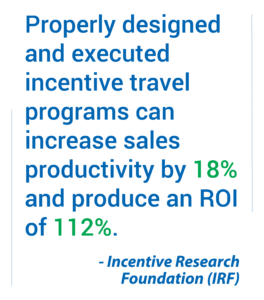
Executives rightly want proof before committing budget. Fortunately, incentive travel has some of the best-documented ROI in the industry. According to the IRF, well-designed incentive travel programs increase sales productivity by 18% and produce an ROI of 112% — for every dollar invested, companies see more than double that back in performance gains.
Retention matters just as much as revenue. Losing a top salesperson is expensive — research notes that replacing one costs 80–200% of their annual salary. Incentive programs help offset that risk: organizations with strong incentive strategies see meaningfully reduced turnover, and engaged teams are considerably more profitable than disengaged ones.
The broader outlook remains strong, too. Despite a slower year for non-cash gifting spend in 2024, the IRF reports that nearly 6 in 10 North American companies expect their incentive program budgets to increase in 2025 – a clear signal that businesses see these programs as a long-term investment, not a discretionary expense.
Common Types of Sales Incentive Programs
Every program should be tailored to your business goals and audience, but most fall into a few recognizable categories:
- Quota-based travel incentives: Top performers who hit or exceed a defined sales target earn a spot on an all-expenses-paid trip.
- Points-based programs: Salespeople earn points for specific behaviors (new logos, upsells, renewals) redeemable for travel, merchandise, or experiences.
- Presidents Club programs: A prestige-driven recognition tier reserved for top performers, often paired with an exclusive travel experience.
- Channel partner incentives: Programs motivating distributors, dealers, or resellers, often tied to purchase volume or market share growth.
- SPIFFs (Sales Performance Incentive Funds): Short-term, targeted incentives that drive urgency around a product launch or seasonal push.
Best Practices for Building a Program That Works
A sales incentive program is only as good as its design. Based on IRF research and our own experience running programs for a quarter-century, here’s what separates results-driven programs from ones that fizzle out:
- Set clear, measurable goals. Ambiguity kills motivation. Every participant should know exactly what earns the reward.
- Make the reward aspirational. The prize needs to feel genuinely exciting — not a consolation prize for doing your job.
- Communicate constantly. Leaderboards, countdowns, and regular updates keep the goal top of mind.
- Choose the right destination for your audience. A reward that resonates with one sales team may fall flat with another.
- Measure and iterate. Track participation, performance lift, and retention so next year’s program is stronger.
Helping you combine all these best practices is where an experienced travel partner makes all the difference. As our own Amelia Boren puts it:
“When you partner with a travel team that actually understands your audience — their preferences, what motivates them, what would make them feel truly rewarded — you stop guessing and start building an experience people will talk about for years. That’s the difference between a trip and an incentive.”
— Amelia Boren, Director of Operations, Ascent Performance Group
Bringing It All Together
A sales incentive program isn’t just a perk. It’s a performance strategy backed by decades of research and measurable ROI. Done right, it aligns your team around the goals that matter most, strengthens retention, and builds loyalty a paycheck alone can’t buy.
For more than 25 years, Ascent Performance Group has partnered with companies to design incentive travel programs that deliver both experience and results. Ready to build a program your sales team will be motivated by? Visit us at ascentperformancegroup.com to start the conversation.
Source data: Incentive Research Foundation (theirf.org)